
MoneyLIVE Nordics roundup: what banks asked, and what’s holding them back
With Ryan Waters, Solution Consultant, Tuum Agentic banking and stablecoins...
By Ove Kreison, CPTO, Tuum · Oct 19, 2026
AI models are probabilistic. Ask the same question twice and you can get two different answers.
A ledger has to be deterministic. The same transaction must post the same way every time, and an auditor must be able to trace exactly why.
When the numbers have to be right every single time, a system that works in likelihoods can’t be the thing you trust to keep them. So every bank adding AI has to decide where it sits in relation to the core.
One architectural answer is to keep AI around the core. AI connects through the same controlled APIs as every other system. It reads, analyzes and recommends, while the core keeps the record, applies the rules and behaves the same way every time.
There’s a commercial logic too. The best model today won’t be the best model in 12 months. When the core and the AI sit in separate layers, each doing its own job, the bank can switch models as the market moves without touching the ledger. That portability lets a bank adopt whatever the AI ecosystem produces and whatever customers start expecting next.
Regulators worry about three things with AI: decisions nobody can explain, models nobody validated, and dependencies nobody can exit. Every one of those problems gets worse when AI sits inside the system of record.
Under the EU AI Act, AI that judges whether a person gets credit counts as high-risk. Banks have to document how it works, log every decision, and keep a human able to overrule it. That’s far easier to prove when the AI sits outside the ledger and every action runs through logged, permissioned APIs.
DORA asks EU banks to manage concentration risk with their tech providers and keep a workable exit plan. An AI layer you can unplug is far easier to defend than one built into your ledger.
And in the US, banking regulators’ guidance on model risk spells out what supervisors expect: any model behind a material decision has to be documented, validated and open to challenge, so someone else can trace the result and get the same one again. The bank stays responsible for that model even when a vendor built it. Keeping AI outside the ledger is how you stay inside the rules.
Supervisors in the GCC and Asia are asking the same questions in their own frameworks.
Here’s what an around-the-core architecture gives a compliance team:
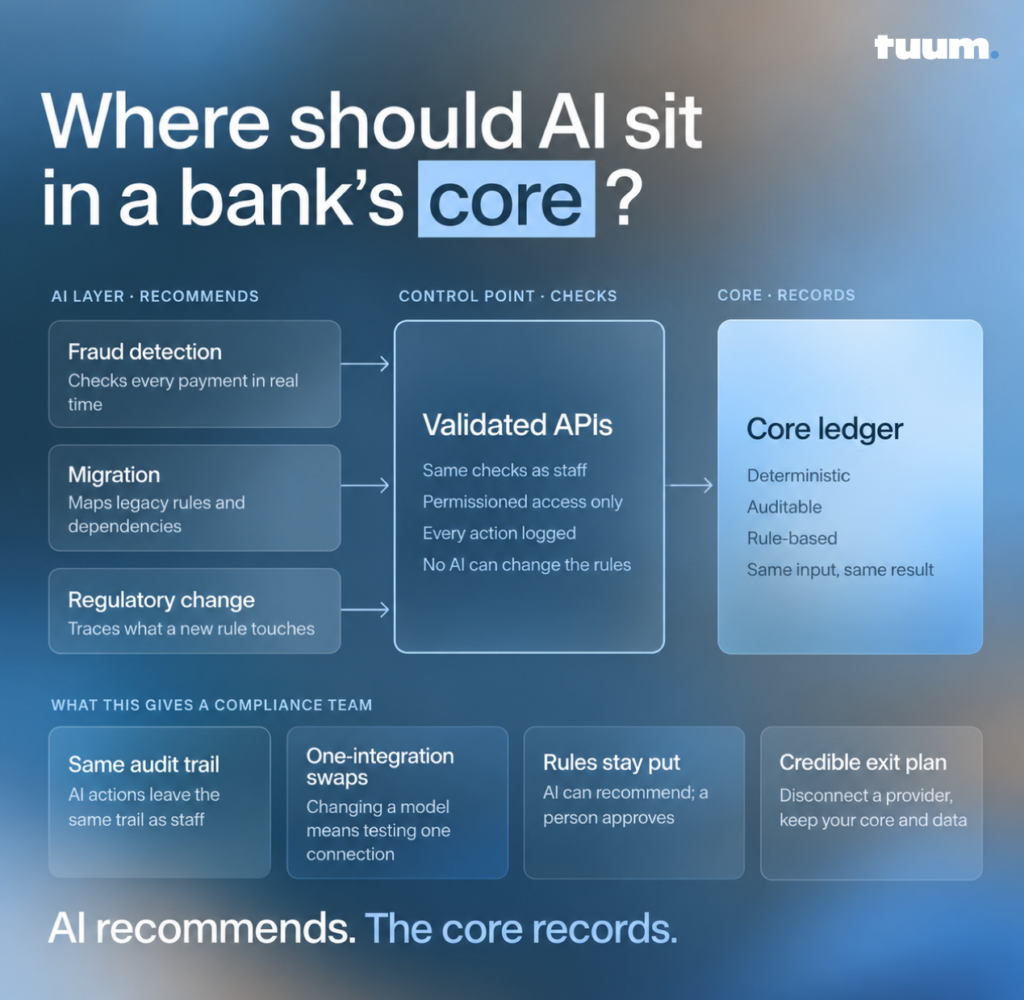
This approach is often called agentic architecture: a core that’s AI-capable today and ready for whatever AI brings next. It should be open to anything worth connecting and closed to anything without permission. In practice, banks should look for five things.
Some of the most valuable AI work in a bank happens one step away from the ledger. AI reads, analyzes and recommends, and the core records the outcome.
The answers show where a vendor’s AI actually sits, and how much control the bank keeps over its own roadmap.


Whether you’re modernizing your core, launching new products, or exploring what’s next—we’re here to help. Get in touch to see how Tuum can support your vision.